Solar Contacts
The relationship operating system for people who refuse to let the people they love drift away.
You have hundreds of contacts.
You actively maintain about 12.
The gap between the two numbers isn't laziness — it's the absence of a tool built for personal relationships.
Every CRM ever built was designed to close a sale.
Not to maintain a friendship.
| Tool | Personal relationships | Privacy-first | Visual health | Frequency tracking | Local AI |
|---|---|---|---|---|---|
| Phone contacts | ✗ static list | ✓ | ✗ | ✗ | ✗ |
| ✗ career only | ✗ sells data | ✗ | ✗ | ✗ | |
| Salesforce / HubSpot | ✗ sales funnel | ✗ | ✗ | ✓ | ✗ |
| Social media | ✗ algorithmic | ✗ surveillance | ✗ | ✗ | ✗ |
| ☀️ Solar Contacts | ✓ built for this | ✓ zero telemetry | ✓ orbit map | ✓ per-person | ✓ Ollama |
Social media doesn't connect you to the right people.
It connects you to the most profitable ones.
Social media algorithms are not optimized for meaningful connection. They are optimized for time-on-screen. The content that makes you angry, jealous, or anxious keeps you scrolling. Outrage is the product. Your attention is the inventory.
Facebook shows you ~3% of your friends' posts — chosen by an algorithm, not by you. The people who matter most to you are invisible. The people who drive engagement (influencers, arguments, viral content) are everywhere. You didn't choose that orbit. They did.
The lonelier and more anxious you are, the more you scroll. Social media companies have a direct financial incentive to keep you slightly dissatisfied. Studies show heavy social media use increases feelings of isolation — the opposite of what they promise.
500 "friends." 300 followers. You liked someone's photo — but when did you last actually talk? Social media creates the feeling of connection while replacing the substance of it. Passive consumption is not a relationship. It is a simulation of one.
No algorithm. No feed. No engagement loop. You decide who is close. You decide the frequency. The app serves your relationships — not a business model built on harvesting your attention.
Make relationship decay visible.
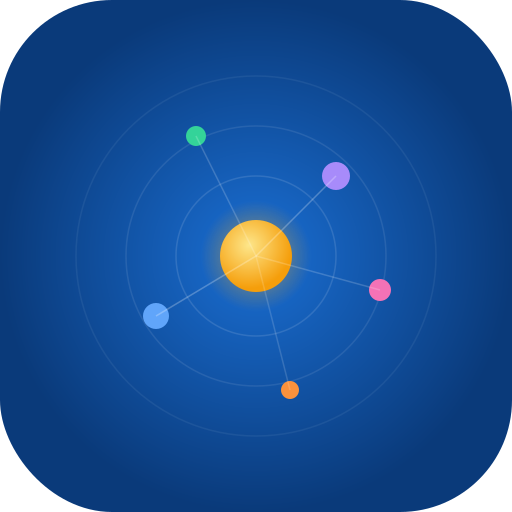
People orbit you. The closer they orbit, the more recently you connected.
Watch someone drift — and feel it before you lose them.
Importance sets the ring. Recency sets the distance. A high-importance contact who hasn't heard from you drifts to the outer edge — and you can see it happening in real time.
The AI runs on your hardware via Ollama. It reads your patterns and says: "You haven't talked to your college roommate in 4 months — here's an icebreaker." Zero data leaves your device.
Every morning, one or two contacts are surfaced based on their orbit position, your stated frequency goal, and AI urgency scores. One tap to call, message, or log.
Log what you talked about. The AI uses this to suggest what to ask next. You never start with "so… what's new?" again — you start with "how did that interview go?"
AI that runs on your machine.
Relationships that stay on your device.
Every other AI tool sends your data to a server. Solar Contacts uses Ollama — a local LLM runner. Your contact list, your conversations, your relationship patterns never reach our servers. Not because of a policy. Because of architecture.
Ollama inference on your laptop or home server. No API keys. No cloud billing. No network required for AI features.
Firebase is your account, not ours. We never have a copy. If you delete your project, it's gone. We cannot access it, ever.
The relationship analysis code is open source. Anyone can verify it does exactly what it claims — no hidden behavior, no engagement manipulation.
Free forever. No ads. No data. No tricks.
Paying to maintain a friendship feels wrong. The app is free because the relationship model demands it. Sustainability comes from people who want to give back — not from monetizing attention.
Core App
Full orbit map, daily suggestions, AI insights, import/export. No limit. Forever.
Supporter
No extra features. Pure support for people who love the app and want it to exist.
Hosted AI
For users without a local server. Privacy-preserving cloud inference — prompts only, cleared after response.
Pro Export
One-time. PDF timelines, calendar sync, professional utilities for coaches & therapists.
Zero data sold. Zero ad revenue. Zero engagement manipulation. The user is always the customer.
Development
Strategy
Who installs it, why they stay, how it grows,
and where it goes in 5 years.
This is the most common objection — and the strongest argument for the app.
"Exactly — you have 300 contacts and actively talk to 12. What are you doing with the other 288? They're not dead. They're invisible. Solar Contacts doesn't replace your contacts. It's what you do with them."
People install apps because of a moment, not a feature list.
These are the moments Solar Contacts must be present for.
The drift realization
"I just found out my close friend went through something terrible — and I had no idea we'd drifted that far."
The missed birthday
"I forgot again. I felt terrible. I need a system before I lose this person."
The life transition
"I just moved cities / changed jobs / became a parent. I can feel my old connections fading and I want to keep them."
The funeral realization
"I wish I'd called more. I'm going to be more intentional. Starting now."
The networking shame
"I only reach out when I need something. I hate that about myself. I want to change it."
The intentional living moment
"New year. New me. I want to be better at relationships. I need a system, not a resolution."
Not a daily driver. A daily glance.
Morning glance — 30 seconds
Open the orbit map. See who's drifted. Check Daily tab. Call, WhatsApp, or snooze. Done.
After a conversation — 60 seconds
Just got off the phone. Open app. Log a quick note. Watch them move back toward the center. Feels good.
Weekly review — 5–10 minutes
Sunday evening. Scan the orbit. Who's in the outer ring that shouldn't be? Set intentions for the week.
The random thought — instant
"I should call X." Open app. Find them. See the last log. See what you talked about. Call prepared.
Primary device: mobile. Core review: desktop. The PWA bridges both without an install barrier.
Seeding: 0 → 1,000 users
Target: intentional living people — they journal, do weekly reviews, read productivity books. They're on Reddit and HN right now.
Build a "Share my orbit" export: contact names anonymized to initials, beautiful image. When someone sees a visual of their social world — some close, most distant — they share it. This is the growth engine before the download link.
- ▸ r/productivity, r/selfimprovement, r/minimalism — personal story, not marketing
- ▸ Show HN: "I built a personal CRM where the AI runs locally — no data leaves your device"
- ▸ r/privacy, r/degoogle — local Ollama AI is genuinely unusual here
The orbit map gif is the hero. Prepare 3 real testimonials from beta users. Lead with the emotional story, not the feature list. Aim for #1 of the day in Productivity.
Give the app to 20 real people in your life. Watch what they say when they see the orbit map for the first time. That reaction is your marketing copy — use their exact words.
Content-led: 1,000 → 10,000 users
Write about the problem, not the product. Rank for searches people do when they're in pain — when the moment has already arrived.
- 📝"Why you're losing friendships without knowing it"
- 📝"The relationship audit: a 10-minute exercise"
- 📝"Why I stopped using LinkedIn for personal relationships"
- 📝"How often do you actually need to reach out to keep a friendship alive?"
- → r/productivity · r/INTP · r/introvert · r/socialskills
- → Building a Second Brain / Zettelkasten communities
- → Obsidian / Notion user communities — they love systems
- → Loneliness research communities and podcasts
"A personal CRM where the AI never leaves your device" — Wired, The Verge, ArsTechnica
"The app fighting the loneliness epidemic one orbit at a time" — Atlantic, Guardian, NYT Wellness
Community & word of mouth: 10,000+ users
Community space
Discord or community forum — not for support, but for people sharing relationship wins: "I reconnected with my college roommate after 3 years because the app surfaced him." These stories spread.
Therapist partnerships
Therapists routinely prescribe social connection. If a therapist recommends Solar Contacts, their patients install it. Reach out to therapy communities. Cost: zero. Conversion: very high.
Ambient presence
iOS/Android home screen widget showing today's priority contact. Apple Shortcuts integration. When users see their top contact on their lock screen, the app becomes ambient — not something they open, but something they live with.
The shareable moment
"Share my orbit" — anonymized image export. When someone shows their orbit map to a friend ("this is my social world"), the friend immediately asks: "what app is this?" That's the highest-converting referral possible.
Podcast circuit
Productivity podcasts (CGPG, Cortex, Deep Questions), loneliness research podcasts, privacy tech shows. One appearance on a relevant podcast with 50k listeners equals 6 months of organic growth.
Open source moat
Open the relationship analysis code. Privacy community will audit it, trust it, and champion it. GitHub stars become social proof. Contributors improve the product. Trust becomes a network effect.
Milestones
& Future Vision
Five versions. Five years. One north star.
V1 Foundation · V2 Intelligence
V1 — Foundation
Now → 3 months- ✅ Orbit map with collision-free node packing
- ✅ Daily call suggestions + urgency scoring
- ✅ Mark contacted / call / WhatsApp timer reset
- ✅ Local AI insights via Ollama
- ✅ Google Contacts + iCloud import
- ✅ Backup & restore with preview
- ☐ Shareable orbit image export (anonymized)
- ☐ PWA install prompt + iOS home screen guide
- ☐ Home screen widget
- ☐ Onboarding — value visible in under 2 minutes
V2 — Intelligence
3–6 months- ☐ Relationship pattern analysis ("you drift in summer")
- ☐ Conversation topic memory for next call suggestions
- ☐ Relationship health score per person + global
- ☐ Life event awareness — birthday & job change flags
- ☐ Smart frequency calibration from actual behavior
- ☐ Offline-first with optimistic background sync
- ☐ AI "Run Analysis" — full orbit health report
- ☐ Suggested icebreakers from conversation history
V3 Ambient · V4 Depth
V3 — Ambient
6–12 months- ☐ Push notifications — one/day, only when meaningful
- ☐ iOS & Android home screen widget
- ☐ Apple Watch complication / glance
- ☐ Siri Shortcuts + Apple Shortcuts actions
- ☐ Quick log from notification (no need to open app)
- ☐ Calendar integration — meetings auto-log as contact
- ☐ "Quick log" voice memo after a call
V4 — Depth
12–18 months- ☐ Shared orbit — couples manage mutual relationships (E2E encrypted)
- ☐ Relationship timeline — visual history per person
- ☐ Interest & topic tracking per contact
- ☐ Gift & event reminders tied to relationship data
- ☐ Reconnection mode — 1+ year gap, guided script
- ☐ Voice memo logging after a call
- ☐ Professional export — PDF timeline for coaches
Become infrastructure, not just an app.
Open API
Third-party integrations with journal apps, calendar apps, note-taking tools. Solar Contacts becomes the relationship layer for the personal productivity stack.
Browser extension
When you're on someone's LinkedIn or email thread, a sidebar shows their orbit position, last contact, and what you talked about last. Relationship context everywhere you work.
Desktop app
Tauri or Electron native app. The orbit map on a large screen, during a weekly review, is genuinely beautiful. Desktop is the reflection surface; mobile is the action surface.
Self-hosted stack
Full Supabase + local Ollama + Docker deployment. For ultra-privacy users. This community becomes the loudest advocates — developers who trust no cloud, who build their own everything.
AI drafts messages
The AI learns your communication style and drafts messages you'd actually send — using your tone, referencing real shared history, matching the relationship's warmth level.
Anonymized insights
Opt-in aggregate data: "How does your relationship maintenance compare to others your age and life stage?" Social norms data is powerful — and it costs nothing to compute locally.
"You wake up, open the app, and it tells you one thing: Your mom hasn't heard from you in 12 days. She mentioned her back has been hurting. A good message might be: 'Hey, how's your back feeling this week?' You tap send. It's done. The relationship didn't decay."
That moment, multiplied across your whole orbit, is the product.
Not a CRM. Not a phonebook. A living, intelligent mirror of your social world
that helps you be the kind of person you want to be to the people you love.
 Solar Contacts
Most apps try to make relationships easier.
Solar Contacts makes them harder to neglect.
The app's job is not to automate relationships.
It is to make the people you love impossible to accidentally lose.